Have your painting examined and valued
A family portrait, a seascape bought long ago, a canvas found in the attic: a painting cannot be judged on its signature alone. We look at the technique, the support, the condition and what the back of the canvas tells us before telling you what it is worth.
The initial assessment is free. If the painting interests us, we can make you an offer to buy it; if it would be better suited to an auction, we tell you that too.
- Valuation
- Free and without obligation
- Where
- From photos, then at your home
- Offer
- In writing, and you remain free to decline
- Hours
- Monday to Saturday, 9 am to 7 pm
The works we examine
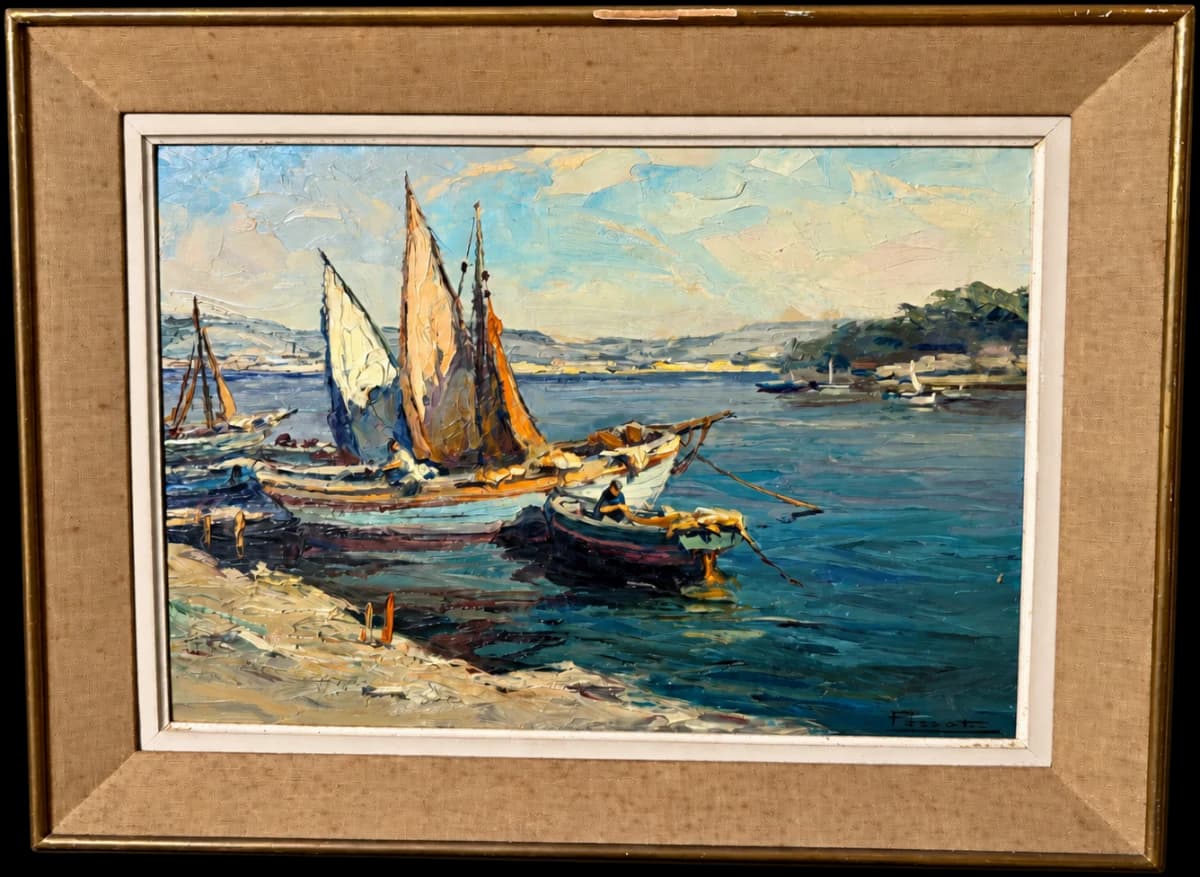
Old paintings
Oils on canvas or panel, portraits, landscapes, genre scenes.
Modern paintings
20th-century works, signed or unsigned.
Drawings and pastels
Drawings, watercolours, gouaches, pastels.
Engravings
Engravings and prints, telling original impressions apart from reproductions.
- Other, or not surePainting or reproduction? Send one photograph of the front and one of the back: that is often enough to begin.Describe the item
What a photograph can show, and what it cannot
Photographs are enough for an initial assessment. They also have their limits, which we prefer to explain from the outset.
From photographs
- Identifying the subject, the likely period and the technique.
- Reading a signature, a label or a stamp on the back.
- Telling you whether an examination in person is worthwhile.
At the examination
- Checking the paint, the brushwork, the support and the stretcher.
- Assessing the condition: restorations, overpainting, craquelure.
- Establishing a valuation and, where appropriate, an offer.
Our valuation is not an authentication: for some artists, only the author of the catalogue raisonné, a committee or the artist’s rights holders can give an opinion.
What helps us value your painting
- A photograph of the front
- The whole painting, straight on, in daylight, without reflections.
- A photograph of the back
- The stretcher, the canvas or the panel, with any labels, stamps and inscriptions.
- The signature
- Close up, with the date if there is one beside it.
- The dimensions
- Height and width of the work, without the frame.
- Technique and condition
- Oil, watercolour or print, if you know; damage, restorations, yellowed varnish.
- Provenance
- Known origin, invoices, certificates, sale or exhibition catalogues.
How the valuation works
You send us photographs
Front and back, with the signature and the dimensions.
An initial assessment
We tell you what we see, and whether an examination in person is needed.
The examination
At your home, by appointment, including for large works.
Your decision
A written offer if we are able to buy the painting, or advice on the best way to sell it.
At your home, anywhere in France
We are based in Chauny but do not receive the public there: we travel by appointment to examine paintings at your home, which avoids transporting a fragile work.
Frequently asked questions
Can you value a painting from photographs?
Yes, for an initial assessment: one photograph of the front, one of the back, the signature and the dimensions are often enough. An accurate valuation generally requires seeing the work.
Can an unsigned painting be valuable?
Yes. Many old works are unsigned, and the quality of the painting, the subject or the provenance count for more. Conversely, a signature on its own guarantees nothing.
How can I tell whether it is a painting or a reproduction?
Under a magnifying glass, a printed reproduction often shows a regular dot pattern and a perfectly flat surface. The back of the work is also revealing. Send us a photograph of the front and one of the back: that is often enough to tell.
Do you issue a certificate of authenticity?
No. We value the work and, if it interests us, make you an offer. Depending on the artist, authentication is a matter for the author of the catalogue raisonné, a committee or the artist’s rights holders.
Should I clean or restore the painting before showing it?
No. Clumsy cleaning can damage the paint layer; restoration is decided after the valuation, and is not always advisable.
Is it better to sell to a buyer or at auction?
That depends on the work. For some pieces an auction may be preferable, and we will tell you so. A direct offer to buy spares you the wait and the sale fees.
Is there a tax on selling a painting?
Depending on the sale price, a French flat-rate tax on sales of precious items may apply. The French tax administration sets out the rules in its official guidance (BOFiP, in French).
Can you come and see a large painting at my home?
Yes, and it is in fact preferable for large or fragile works. We arrange the appointment after an initial assessment from photographs.
Find out more
Have your painting valued
Describe the painting in a few words: an expert will get back to you and tell you which photographs are useful.
- Telephone
- +33 7 57 99 00 67
- Opening hours
- Monday to Saturday, 9 am to 7 pm
By appointment - Address
- A.F Conclues
142 Rue de la Chaussée
02300 Chauny
Tell us about your pieces
Free, confidential valuation.
An expert will call you back within 24 hours.